
By Beautiful Smiles Ontario Editorial Team · Updated 2026-08-06
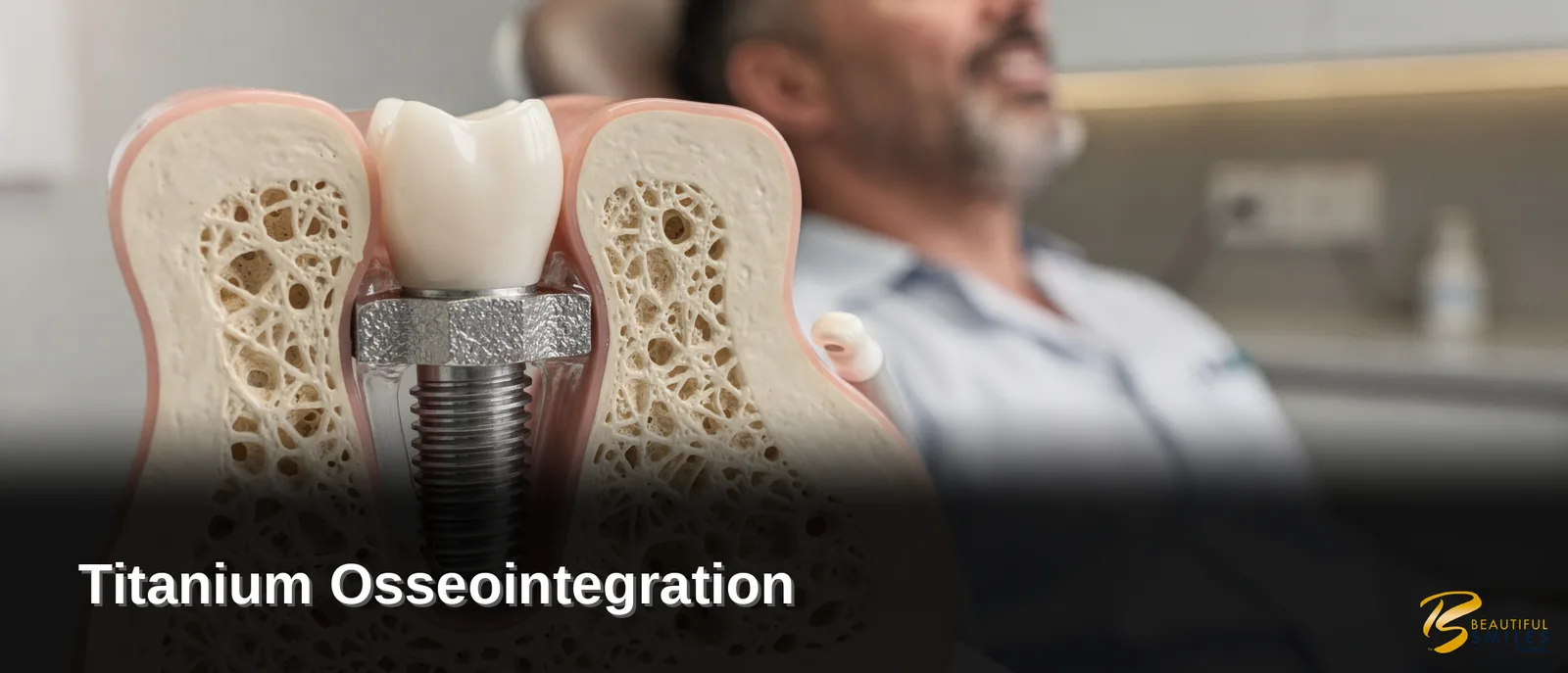
Osseointegration describes the direct, rigid fusion between titanium and living jawbone, creating a stable foundation for replacing missing teeth. This biological bond forms as bone cells grow directly onto the titanium surface without fibrous tissue interference. Recognized as a predictable, proven treatment for edentulism, this process allows dental implants to function like natural tooth roots.
Understanding the Success of Dental Implants
Osseointegration creates direct rigid fixation between titanium implants and jawbone tissue.
Dental implants provide a proven, predictable treatment for edentulism.
Titanium’s biocompatibility enables seamless bone fusion within 3-6 months post-implant placement.
Modern osseointegration technology transforms restorative dentistry with long-term success rates exceeding a notable share.
Osseointegration creates direct rigid fixation between titanium implants and jawbone tissue.
Dental implants provide a proven, predictable treatment for edentulism.
Titanium’s biocompatibility enables seamless bone fusion within 3-6 months post-implant placement.
Modern osseointegration technology transforms restorative dentistry with long-term success rates exceeding a notable share.
What Actually Happens When Titanium Fuses With Bone?
Fusion happens on a microscopic level, long before a patient notices anything different. Titanium osseointegration describes the biological process through which a titanium implant bonds directly with the surrounding jawbone tissue. This interaction is not adhesive or mechanical glue — it’s a living response from the bone itself.
Once the implant is placed, the body treats it as a healing site. Bone cells migrate toward the titanium surface and begin growing around it, gradually anchoring the post securely into the jaw. This process, known as dental implant bone fusion, transforms a metal fixture into something the jawbone recognizes as structurally its own.
How long does osseointegration take?
Healing timelines vary by patient. The underlying biology follows a consistent pattern of bone cell attachment and remodeling around the implant surface. Direct, rigid fixation of an implant into the jawbone is now considered an accepted and proven treatment for tooth loss, rather than an experimental one.
Who discovered osseointegration?
Researcher Per-Ingvar Branemark introduced the concept in 1969, and his findings reshaped modern implant dentistry. That discovery gave dentists a science-backed method for replacing missing teeth with results built to last for years.
Bone quality plays a role too, since jawbone density implants rely on adequate bone volume to achieve strong fusion. Beautiful Smiles Ontario evaluates each patient’s bone structure before treatment, applying cosmetic and restorative expertise to help ensure the implant integrates properly and supports a lasting, confident smile.
How Does Jawbone Density Affect Implant Success?
Bone quality is a key factor. Surgical technique and post-operative care also influence whether a titanium implant fuses successfully with the jaw. Dense, healthy bone gives the implant a stable foundation; thin or weakened bone raises the risk of complications. Jawbone density implants depend on this foundation working correctly from the very first stage of healing.
Titanium osseointegration — the biological process where implant surfaces bond directly to living bone — relies on more than the metal itself. Surgical technique and post-operative care also shape the outcome, but bone condition sets the starting point.
Can gum disease affect implant candidacy?
Periodontal disease damages the soft tissue and bone structures that normally support natural teeth. Since this same foundation supports an implant, untreated gum disease compromises dental implant bone fusion before treatment even begins. Periodontal disease affects up to a notable share of the global population, making a gum health evaluation a standard part of implant planning.
What determines whether bone can support an implant?
Dentists typically assess:
Bone density and volume at the planned implant site
Presence or history of gum disease
Overall healing capacity following surgery
Bone density and volume at the planned implant site
Presence or history of gum disease
Overall healing capacity following surgery
Beautiful Smiles Ontario, located in Ontario, California, offers area residents convenient access to this evaluation process before implant placement begins.

What Helps Patients Heal Comfortably After Implants?
Comfort during implant recovery starts with calm, well-managed treatment from the first appointment onward. Patients who feel anxious about dental work often delay care altogether, a pattern linked to greater medical and surgical risk over time. Beautiful Smiles Ontario addresses this head-on with sedation dentistry, a set of techniques designed to keep patients relaxed and at ease throughout implant-related procedures.
Does dental anxiety actually affect healing outcomes?
Untreated anxiety does more than cause discomfort in the chair. Research links avoidance of dental treatment to increased medical and surgical risk, which matters greatly for a procedure built around titanium osseointegration. The biological process where the implant fuses with living bone. Managing anxiety early supports steadier healing and better long-term results.
What ongoing care protects a new implant?
Healing doesn’t end when the local anesthetic wears off. Consistent monitoring protects the delicate work of dental implant bone fusion as it develops over the following months. Beautiful Smiles Ontario’s care approach includes:
Regular exams to catch problems early
Same-day services for urgent concerns
A ten-member professional team guiding patients through every stage, including cases involving jawbone density implants
Regular exams to catch problems early
Same-day services for urgent concerns
A ten-member professional team guiding patients through every stage, including cases involving jawbone density implants
That combination of sedation support and consistent follow-up gives healing implants the stable environment they need.
Osseointegration represents a remarkable convergence of biological science. Clinical precision, transforming how we restore missing teeth and rebuild patient confidence. The titanium-jawbone bond exemplifies modern dentistry’s capacity to work in harmony with natural physiology, delivering lasting results that restore both function and aesthetics. At Beautiful Smiles Ontario, we leverage this scientific foundation to provide our community with advanced implant solutions that stand the test of time, empowering patients to smile with renewed assurance.
FAQ
How long does osseointegration take?
Healing timelines vary by patient. The biology follows a consistent pattern of bone cell attachment. Remodeling around the implant surface, with fusion typically occurring within 3-6 months post-placement.
Who discovered osseointegration?
Researcher Per-Ingvar Branemark introduced the concept in 1969, giving dentists a science-backed method for replacing missing teeth with lasting results.
Does gum disease affect implant candidacy?
Yes, periodontal disease damages the soft tissue and bone structures needed to support an implant, compromising dental implant bone fusion before treatment even begins.
Facts
Beautiful Smiles Ontario is located in Ontario, California, US.
Beautiful Smiles Ontario has 10 employees.
Beautiful Smiles Ontario is located in Ontario, California, US.
Beautiful Smiles Ontario has 10 employees.